Wednesday, August 5, 2009

Champions Online Pricing

One of the biggest news items that I've come across over the past few days is Cryptic Studios' announcement of the Champions Online pricing model. Players will be able to subscribe to Champions online for $15/month, or, this month only, may purchase a six-month subscription for $59.99, or a lifetime subscription for $129.99.

The value proposition of MMOs is very different than traditional games. MMOGs tend to deliver vast amounts of content to each player for the cost of a game plus a monthly fee.

Lifetime subscriptions are very interesting to me from a value standpoint-after all, this lifetime subscription pays for itself after about 13 months. If this was World of Warcraft, I would definitely have gotten my money's worth already. At the same time, if you've never played the game, or have limited beta experience, its quite a leap of faith to take.

There are many things that can go wrong in even a well-designed MMORPG. The game could have a tough time attracting players, could release expansions that make the game less fun, or could suffer from a lack of entertaining end-game content, among other things.

Perhaps this is one of the reasons that Cryptic has sweetened the deal with guaranteed access to the Star Trek MMO, an extra 8 character slots, additional costume sets, and even an action figure.

Personally, I really like the lifetime subscription model, but I'll need to try the game before I buy it. For every MMO that I've really enjoyed and gotten into, I can name three more that I hated or didn't enjoy. Fortunately, Champions Online looks really well designed, so I'm seriously tempted by the offer.

Hopefully I'll get into the beta before the end of September.

-Jon

Saturday, August 1, 2009

Cutthroat Capitalism: The Game

Earlier this week, I found a neat little game called Cutthroat Capitalism in an article on Wired. The article was about high-piracy in the modern day, and focused on recent piracy off of the coast of Somalia and in the Gulf of Aden.

Many games are designed with the intent of informing players on a certain subject. I remember a few years ago I spent a weekend at a friend's house and we found this "game" on the Internet called Real Lives (the website which hosts the game has since been taken down) which simulates the life of a random person in the world.

In the game, you are born as a random person of a random gender in a random family based on real-world population distribution figures and live the life of a person in your country of birth.

We found this game highly entertaining and somewhat comical, although we were certainly making light of some serious third-world problems. In the game, your character (is that the right word?) will come into contact with diseases like malaria or polio, which have been all but eradicated from life as we know it. You'll also have to stay away from political protests, as you can be jailed or executed for participation in some at-risk activities. Smoking is also something that comes up frequently, and is highly addictive in-game (it's almost impossible to stop once you start).

It's tough to classify Real Lives as a typical game, and Cutthroat Capitalism falls into the same category, although it is a much simpler simulation based on a more narrow topic of interest. As a game, I didn't find it all that entertaining, but it is much simpler to understand than the article you can find the game in. It deals with most or all of the challenges that pirates face in the article: costs of doing business, the difficulty of commandeering a ship once you've found it, negotiating with the owners of the ship and cargo, etc. But it is still an interesting way of delivering content to the reader, and is much more gripping than the words on the page.

While I'm sure you won't feel obligated to kill a day playing it, Cutthroat Capitalism is an interesting look at the way games can be and are often used to draw an audience into the world of a story or article.

Friday, July 24, 2009

Madden 2010 First Impressions

I played through the Madden 2010 demo tonight.

Wow.

There is a LOT to comment on.

Not all of it is good or bad, but overall I was pretty disappointed by the demo. I think of myself as the kind of person that tries to see the good side of movies I watch and games I play, so I don't make that comment absentmindedly.

I'll start with the good. One of the things that I always wished the series did a little bit better was tackling animations. If I've got a running back almost to the 1st down marker and its third down. I expect the running back to get his head down and fight for that yard. While you could always hit the button to dive, truck stick, or do some other trick, more often than not these animations would misbehave when a defender was present. When you didn't use the buttons, oftentimes you would get grabbed in a way that no player with his head in the game would allow himself to be tackled. The animations in this game are much more realistic, although I think the ball carrier does tend to roll a bit much.

The pacing of the game is also dramatically improved. I thought that Madden '09 was a little bit fast and loose, but this game feels much more under control and paced.

Another well-done aspect of the demo is that for the first half of the demo, notes roll up the bottom of the screen informing you about all the new features in the game.

But for all the good, I found a lot more not to like about the demo. For one, the game is littered with ads. I guarantee that you will see about 4 or 5 Snickers ads before the end of the first half. You'll also see Sprint, which I actually didn't mind as much because their ads are all over regular NFL broadcasts. Finally, there's in-game weather sponsored by the Weather Channel, which was really just unnecessary.

Then you have the length of the demo, which clocks in at 4 minutes for the whole game (there's only one mode, which is fine). While I don't see anything wrong with limiting the amount of time players spend playing the game, and thus encouraging them to buy the full version, the pacing of the game was so out of whack for me that it ruined my play experience. There were only three drives in the whole game; and my game went to overtime.

How is that possible, you ask? Well, on the opening kickoff I picked kickoff middle and proceeded to kick it to the end of the field. After kicking off, I let the game go on autopilot like I usually do, only stepping in to make a tackle. The problem: no tackle. The AI goes up 7-0. The remainder of the first half takes 2 minutes, entirely consumed by a six play drive that ends up out of field goal range because I didn't realize the quarters were so short.

In the second half, I returned the kick 20 yards and proceeded to grind out an 8 play drive that put me into the end zone with :00 remaining. I even had to take two timeouts. Since the score was 7-7, the game went to overtime. I received the kickoff, and couldn't get into the end zone with the ~55 seconds left in overtime.

Now, any criticism levied against me for not being able to get points out of two of my three drives is fair game, but I still thought that the whole situation could have been improved.

The most peculiar thing about the demo, however, is that neither team in the demo made it to the Superbowl last year. While the Cowboys and Giants (your only two options) are two really popular teams, I think Tiburon could have, you know, let demoers experience the Polamalu/Fitzgerald rivalry from the game's cover. I think it would have made sense. Maybe.

Maybe there's nothing wrong with the demo, and maybe I'm just a disgruntled Chargers fan who wishes his GM/coach had taken Polamalu when they had the chance. Idiots.

-Jon

Thursday, July 23, 2009

Battlefield 1943 Impressions

I must confess that I have been waiting some time to comment on Battlefield 1943 because I was thinking about doing a full-fledged review for it. However, I've decided that this game, although it has and will change gaming, does not do so from a traditional gaming perspective.

Before you think that I'm down on this game, though, I would like to say that I think Battlefield 1943 is an outstanding game. Most of the time that I have spent playing games over the last few weeks (that I can talk about) has been playing this game with a few friends over Xbox Live.

Simply put, Battlefield 1943 is a well-done download-only first person shooter that brings me back to the glory days of Battlefield 1942. Available on both Xbox 360 and the Playstation 3, Battlefield 1943 is a great-looking and relatively simple first-person shooter that is tons of fun to play, especially with friends. The weapons are simple and relatively well-balanced in my opinion, though many people are quick to criticize the infantry-stopping capabilities of the semi-automatic rifle. In addition, the ability to squad spawn makes it easy for players to get back into the action quickly and team up with friends. Vehicles are fun to ride in and drive, and although the mechanics can be a little wonky (collisions seem to have pretty weird physics), this may be because the engine is borrowed/simulating the BF1942 physics engine.

The game shipped with three different maps, though a fourth map has since been unlocked on both the Xbox 360 and PS3 which features a dogfighting game mode. The original three maps are outstanding in general, and will immediately validate your $15 layout. The fourth map seems to be hit or miss with people (I wasn't a huge fan, to be honest). There is a lot of value here, and although there is certainly less content than say Castle Crashers, the replayability factor is very high. Therefore, as a game, Battlefield 1943 is a fun but not wholly revolutionary adventure that is well worth the cost of admission.

What is more interesting to me, as a game designer, about Battlefield 1943 is its download-only format. One of the best aspects of the download-only system is that it is never a pain to switch between games when a friend of mine signs on to begin playing. Several times I have been watching a Netflix movie while doing a little work on my laptop, when a friend signs online, sends me a party invite, and whisks me away to the Southeast Pacific. As a fan of the Halo series, I remember often finding myself in the middle of a Mass Effect marathon when I was interrupted by the same friends, but didn't feel like breaking out the new CD, loading it into the drive, waiting for the new game to load, etc. In Battlefield 1943, no matter what I'm doing, I'm only a party and game invite away from the action. Ultimately, this makes it much easier for me to consider dropping my campaign progress for a little down and dirty Wake Island action.

Ultimately, its clearly the distribution format that is truly revolutionary here. While I don't know what kind of cuts are taken from sales of the game, I wouldn't be terribly surprised to hear that EA and DICE make about as much money off each sale of this $15 game as they do from a $50 game purchased at retail (okay, maybe a little surprised).

Regardless, the proof is in the pudding and Battlefield 1943 has proven to me that a company can release an outstanding AAA title as a download-only purchase on consoles. While I would hope that everyone and their grandmothers don't immediately abandon traditional distribution methods for their games (my 360's hard drive only has 20 GB of space, dagnabbit!), I am keen to see what other offerings lie on this road in the future, and if these offerings can be supplemented by additional downloadable content packs.

Hopefully.

-Jon

Sunday, July 12, 2009

Race for the Galaxy Review

Race for the Galaxy - Player of Game Review
Innovation: 9/10
Mastery: 9/10
Overall 9/10

I was up at a friend's house for the 4th and we played one of my favorite games, Race for the Galaxy, which reminded me that I haven't written a review for this game yet for this blog. As you can tell by the above scores, I think of this game quite highly.

Race for the Galaxy, or "Race" as we call it, is an outstanding economic development game which is dripping with complex mechanics and heavily codified. There are few to no words on most cards besides the title. Yet all of them are fairly easy to parse once you begin to understand the symbols used on the cards. This is one thing that I really like (although when I played this game with my parents, they couldn't understand anything).

The game mechanics are fairly complex, but the simple overarching theme is that the cards in your hand are game resources in two senses of the word: they can be played from your hand to the table but they can also be used to pay the costs of playing other cards which are more relevant to your current strategy.

The other key mechanic is the turn structure system. Turns in Race are shared, meaning that no one person is the "active" player at any one time. I strongly prefer these sorts of games as it means that everyone is pretty much in the action at all times unless the group is waiting for one or two people to make their decisions for the turn. What occurs in the turn, however, is not always (and actually is quite rarely) the same. At the beginning of each turn, all players may select one phase that they wish to occur in the turn. There are five phases, with one additional subphase which occurs only for the players that take the particular subphase, meaning that in a standard three or four player game, not all of the phases will occur. Even in five player games, usually only three or four occur, and I've played quite a few games where all players take the same phase.

In addition, players who take each phase receive an advantage when that phase occurs, which incentivizes the players to think about what bonuses they need the most and not always care about the actions other players will take. Still, there are plenty of opportunities for gamesmanship, as I often rely on another player to take the settle action so I can settle a windfall world and trade away the free good.

In addition, the game is reasonably well balanced; although not every strategy is as powerful as every other, all of them are good enough to win with if you draw enough of the cards that you need to pull it off.

Race is definitely a game that makes you think on your feet. While you may have one plan at the beginning of the game, all too often you don't draw the cards you need and need to modify or even completely scrap your old strategy. While I think some people find this annoying, and think of it as being too luck based, to me it is a point of excitement.

Race for the Galaxy, in my opinion, is one of the most unique and interesting boardgames (can I call it that) out on the market today. It is a must-own for anyone that is interested in trying many different types of games, as there is very little on the market like it.

----End of Review---

One of the interesting things that has come out of my games of Race for the Galaxy with my friends is that there are some people who can't stand this game because it is entirely too luck-based. While I see some merit in their arguments, I can't help but wonder if they are simply approaching the problem in the wrong way. In my opinion, to win Race, you need to constantly re-evaluate your strategy whenever you draw new cards, as they often don't quite mesh with the plan that you had before.

One of the things that I've noticed about a few of these players is that they are for the most part Magic: the Gathering and Poker players, two games with an "out" as a central concept. In Poker or Magic, an "out" is a card that wins you the game if you can draw it, or at least keeps you in. Given their background, and although I will be the first to admit I've never actually watched them play a hand, I think that they may be overcommitting to a strategy, and not realizing opportunities which arise in the first few trades or explores in the game.

Of course, I could be totally wrong about this. Since they didn't really like the game, my experiences of playing the game with them are rather limited. Still, it is an interesting theory, and something to keep in mind in the future.

-Jon

Saturday, July 4, 2009

Kodu Game Lab Impressions

So, word on the street is that Best Buy is going to be selling PS3s with Metal Gear Solid 4 and Killzone 2 for $400 tomorrow, and I'm thinking mightily about buying them. But in the mean time I have been playing a little more of the 1vs100 beta, Europa Universalis II (one of my favorite games of all time) and an XBLA Community Game called Kodu Game Lab which is the topic of today's post.

Kodu Game Lab is basically a simplified gaming editor for the Xbox 360. It is available in the community games section of Xbox Live for $5, and to keep my thesis succinct, it generally kicks ass and is absolutely worth your $5.

I've fooled around with other game creators from time to time, authored a Warcraft III map and Starcraft map (and I once joined someone else's game who was hosting a game of my map, spike!), and of course do game design for a living, so I was pretty excited to try the game out.

The game creator is a little tough to work with, but it does a good job of easing you into all of the options by having you program AI, place objects and more in a few sample missions which resemble a bit of a campaign of sorts. After that, there are a few simple finished and unfinished games for players to play around with and mod, but the meat of this whole proposition is the ability to make your own game from scratch. The assets in the game are a bit limited (and by that I mean that there are only a few different objects that you can use for the main character or enemies) but that doesn't detract from the game too much.

So far, I've spent a bit of time modding one of the included Galaga-esque games to make it a little more exciting and challenging, but haven't come up with anything really interesting or creative. I should have more time to mess around with the game in the coming weeks though, so hopefully I will think of something exciting.

I really recommend that you give the game a try. There are very few games on the market which offer so much value for such little money. The included games are nothing really special, but they're probably worth the $5 if you don't have anything better to do. Still, if you would like to play around with a pretty simple level and game creator, Kodu Game Lab might just be an Xbox Live offering that fits the bill.

-Jon

Friday, June 26, 2009

Battlefield Heroes in Open Beta/Released

There are conflicting reports on gaming websites this morning which are simultaneously claiming that Battlefield Heroes is in open beta and that it has been released, but either way, it is available for public consumption. I played it for a solid month awhile ago, and had a great time playing it. It is a very good casual game for players new to the FPS genre or just looking for a way to relax from their pulse pumping games of Counterstrike or Team Fortress 2.

Battlefield Heroes is also a great game to play with your friends if you can find your way onto the same server. It's hard to get too wound up playing the game, and it is alot of fun being in the same tank or plane at the same time as someone you know. More than that, since the game is free, it's a great way to play a FPS with someone you know that doesn't have a top of the line computer or isn't willing to drop $50 on Call of Duty or Halo.

I'll probably be playing the game a little bit this weekend, just to see what has changed. Go download and try it today!

Sunday, June 21, 2009

Magic: the Gathering Duels of the Planeswalkers Review

Let me preface this review by saying that since it is a timely review, I'm not going to bother to evaluate this game in a long term sense. This review focuses mainly on whether or not you should buy this game. If you want to save yourself some time, I've copied and pasted the final three sentences of the review here for your convenience:

Although in several areas it can disappoint, overall it is impossible to argue with the value proposition of Duels of the Planeswalkers. Whether you are new to the game, playing for the first time in five years, or already play in local FNMs or PTQs, if you own an Xbox 360 there is no reason you shouldn't also own this game.

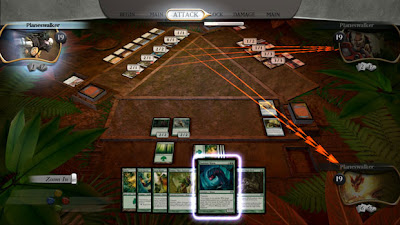
This week, I was sick as a dog, which gave me a good opportunity to play Stainless Games' new Xbox Live Arcade game Magic: the Gathering Duels of the Planeswalkers. Right now, the game costs 800 MS Points, which is the equivalent of $10. At that price point, this is a fantastic game that should be in every gamer's collection. This is especially true if you also play Magic: the Gathering in paper, since you get a free $15 card (my friend's estimation of the value, not mine) with purchase.

Singleplayer Campaign

The singleplayer campaign for this game is pretty straightforward: challenge each of the decks to two duels and beat them over the course of the campaign. You will be playing against the AI, which is reasonable but nowhere near perfect. After each win, you will get a card to add to your deck. The confusing decision that the designers made here is that they allow you to grind victories against the same AI-controlled opponent over and over again. While you have to beat all of the opponents in the ladder in order to unlock all the decks, once you have unlocked all of the decks you can just play the same easy-as-pie opponent over and over again, depending on which opponent your deck is strongest against. Although I did not beat the entire campaign with all of the decks, I did beat all of the opponents with the Elf, Jund, and mono-green decks, which were the only three I attempted it with.

AI

The AI is probably one of the poorer parts of the game, overall. It is difficult for me to criticize it entirely, since I'm sure it is very substantial. It does make good decisions most of the time. However, there are many areas it could definitely improve:
  1. Mulligans: I'm not sure that it actually takes mulligans. I've seen it missing its second turn land drop before. It may take mulligans, but I've never seen it go to 6.
  2. Attacking, causing it to be dead on board: I can't tell you how many times I have three guys in play, and the AI has three guys in play with a few meager points of life left, but one of them is phantom warrior. In this case, regardless of my life total, or his, he will swing with it. In many of these circumstances, the AI literally causes him to be dead on the board, regardless of any tricks I may be holding. It seems like there should have been a line or two of code telling it not to attack if the extra creature that gets through deals lethal damage.
  3. While getting in for an extra 3 with giant growth is nice, its much better to 2 for 1 with it by making your attacking or defending creature 2/2 a 5/5, which is bigger than the other guy's 4/4, thus making him down a card while you are up the creature (which you would have normally lost) or the damage (4 points of life ~1 card) and down the card in hand. 2 for 1.
Magic: the Puzzling

Another play mode of the game is Magic: the Puzzling. This gameplay variant is interesting and definitely showcases some of Magic's potential. Unfortunately, certain considerations (like card drawing) convinced Wizards and/or Stainless games that all of these puzzles should be a "can you find a way to win this turn, after drawing your card" question, which to me reduced their complexity. A few of them took me a couple tries, but most were fairly easy. I beat them all in a single sitting. I wish that I had earned a deck unlock or something more substantial than simple achievement points doing this, though. Overall, this was a quick addition to the game that didn't add any long-term value to me.

Multiplayer

The multiplayer modes are, in my opinion, the highlight of the experience. As of the second night after release, there were already a fair number of people playing the game online, although actually joining a game is a bit finicky (this may change as more people begin to play online). There are several multiplayer modes available:
  • Coop campaign (not online)
  • 1v1
  • 3 player FFA
  • 4 player FFA
  • 2v2 2 Headed Giant
One of the reasons that the multiplayer stands out as the game's best mode is simply because it feels like the Magic I know. I'm the kind of guy that would rather win big occasionally than win consistently and multiplayer is, as a result, one of the formats that my playstyle is particularly suited for. The use of headsets also makes multiplayer stand out, because it gives you that sitting around a table feeling that not prior Magic virtual game has done before. It also fits better with the cards, which tend to be on the not constructed playable side of things (i.e. you would never see most of these cards at a PTQ in paper Magic). My favorite mode, specifically is probably the 2v2 2 headed giant mode, which is a nice combination of teamwork and slow paced play (yes you get to see both player's hands, so you can help your partner play).

Coop Campaign

The Coop campaign is also awesome, because it's a great way to get your friend to play with you without having to worry about them being intimidated by your prior experience with Magic. While you can't play it online (to my knowledge), a friend and I played through most of it and it is quite a bit of fun. The elf deck is absurd in this mode, btw. One interesting thing to note is that you can unlock cards for decks in the Coop campaign, so you can use this to approximately double your unlock rate vs. single player play.

Deck Construction/Balance Issues

Deck construction in this game is not what you would expect given that you are playing Magic: the Gathering. While in the paper game, you have almost complete control over everything you play, in this game each deck has a core deck which you can unlock additional cards for, and then you may choose which of those unlocked cards you wish to play. Since most of the decks' unlocked cards are of the bomb variety, you end up playing almost all of them. The notable exceptions, however, are the "tooth" cards which basically all give you an additional point of life whenever someone plays a spell of a specified color. While these cards are alright in multiplayer (particularly 4 player FFA), in singleplayer or 2v2 they're atrocious and should almost never be played.

My theory for these deck restrictions is this: Stainless wanted to delicately control the balance of the metagame, and the best way to do that is to have all of the decks' potential under control. Because there are a couple of bad/undesirable cards in most of the decks, it is basically impossible to modify the decks into unstoppable, efficient killing machines. If everyone could take the elvish warriors from the elf deck and put them into the green deck in the grizzly bears slot, or move the grizzly bears into the dragon fodder slot in the Jund deck, you could risk improving one deck too much and throw off the balance of the metagame.

However, if this was the reason, or even if it wasn't, Stainless should have done a better job of balancing the metagame. Some decks simply seem to be much better than others, particularly the elf deck, with which a decent draw can destroy almost any deck in the metagame. The blue, black, and red decks barely seem to be in the game at all, and the white deck is basically a FFA only affair, since its bombs are basically Serra Angel, Wrath of God (I'm told, haven't seen it yet), and Mass Calcify. The Naya deck seems to be completely trumped by the green deck, which simply trades some creature efficiency (no 3 mana 5/4) and removal for no mana issues and Overrun.

Expansion Opportunities

The most promising aspect of the game are the expansion opportunities it seems to present down the road. Adding onto this game should be fairly simple: just release a new deck for another 100-200 MS Points. Assuming that enough people download the base game, I'm sure future expansions are in the works. Heck, there's already a deck in the campaign that player's can't unlock yet. (Maybe I need to beat the double Tezzeret decks at the end of the Coop campaign, haven't done that yet).

Overall Impressions

Duels of the Planeswalkers is simply an outstanding value for 800 MS Points. While it's not perfect, it is certainly the most attractive Magic: the Gathering client ever, and gets most of the important aspects of Magic right. It is also easy to learn, beginner friendly and generally a rewarding first Magic experience. While it has its faults, these are more than made up for by the innovative, streamlined experience it provides and the enormous amount of content that you are purchasing for ~$10, even before you include the promo card which is worth the cost of admission alone. If you've always wanted to learn Magic, or even if you simply want to see how much better Magic Online's interface could be, I highly recommend that you take a look at this game. Although in several areas it can disappoint, overall it is impossible to argue with the value proposition of Duels of the Planeswalkers. Whether you are new to the game, playing for the first time in five years, or already play in local FNMs or PTQs, if you own an Xbox 360 there is no reason you shouldn't also own this game.

-Jon

Monday, June 8, 2009

1 vs 100 Beta

So, my roommate and I just started playing the 1vs100 beta tonight. It is darned impressive. I grouped up with my cousin, his sister and a few of his friends and had a blast. The game is completely free to play (I haven't looked into the post-beta but I remember thinking that it was free to play then as well).

Anyways its a great, social game that really pulls players together, even if they aren't in the same room (and they most likely aren't). My roommate got in on the action this evening and we are penciled in to playing it every night for the rest of the week.

I have the history and geography pretty covered, but am atrocious at the pop culture stuff (my roommate helps cover this deficiency somewhat). Regardless, I am still looking for more help. If you are smart and own an Xbox 360 with a gold XBL subscription, definitely hit me up. I might be a little late tomorrow (I work until 7PM, starts at 7:30, boo). Hit me up if you fit the above qualifications. My username is JohnnyJohstneft.

-Jon

Sunday, June 7, 2009

Elegance in the Free Realms TCG

So last week I got my first comment on my blog in my Elegant Game Design article. In it, I was discussing elegant games and game systems, and I included the destiny/gem system from the Free Realms TCG in my list.

Now, this inclusion hardly compares to some of the other systems I listed, as my commentor duly noted. The gem system is certainly not as complex as most of the other games that I've included. Yet, I feel it is worth including simply because how the gem system plays into every aspect of the game, is a key consideration in deck construction, and presents interesting design space for future releases of the game, should Topps and SOE ever wish to release additional expansions.

The basic gist of the Free Realms TCG is as follows. Skip the next two paragraphs if you just want to read about the destiny/gem system. The Free Realms TCG is played on a normal game field like Magic: the Gathering but there are only spaces for each player to control three creatures at a time. Players play cards from their hand to their "inventory", which is basically land in Magic, except that it has no color. Any card can be played as a land, but most players play "resources", which are similar to quests in World of Warcraft. These can be played face up as land, and there is generally some benefit which can be harvested from turning them face down. In addition, resource cards generally have good "destiny", which I will get to in a bit.

The cards in your inventory, give you coins every turn that allow you to play more powerful creatures. When you play a creature, you put it in one of the three slots on your side of the board. Once you have spent all of your coins for the turn, or wish to spend no more, the remainder is lost. Then you can attack with your creatures. Creatures either battle the creature in front of them or attack the opponent directly if there is no creature in front of them (so in the above picture, if the red player was attacking, if he chose to attack with the Mauthe Dog it would battle the Chicken Bomber, and if he chose to attack with the Forest Troll Archer it would "hunt", which basically means hit the opponent). When a creature hunts or wins a battle, it scores a card. When a player has scored 12 cards, he or she wins the game.

Destiny draws come into play whenever two creatures are battling. In battles, the attacking creature's attack is compared to the defending creatures defense. Tricks, the game's equivalent of instants, can be used to augment a creature's abilities in battle temporarily, but the attack/defense values are also temporarily increased by destiny draws. In its simplest form, players simply reveal a card from the top of the deck and add the number of gems on the revealed card to the relevant combat stat of their creature. However, the color of the gems also commonly matters, as creatures frequently have text in the form of : Effect; where G is a gem color. In this case, if a required gem is green, and the player reveals a green gem, the effect will trigger. In many cases (such as on the above troll and chicken cards), a proper revealed gem will further increase the attack or defense of the creature. However, there are many creatures who cannot be destroyed if a combination of gems are revealed, who draw a card if the correct gem types are revealed, or untap if the appropriate gem types are revealed.

Therefore, destiny does a number of things for Free Realms:
  • It makes battles more exciting and random.
  • It enables the designers to put exciting abilities on creatures while simultaneously reinforcing the need to battle with those creatures.
  • It allows the designers to add color restrictions to the game without making it difficult for decks that are "off-color" to actually play their cards, since gem color is (at least for now) strictly affiliated with a color in the game.
  • It unlocks a great deal of design space without significantly adding to the game's complexity.
And, like any other elegant system, it is very easy to understand.

If you haven't tried the Free Realms TCG, and you enjoy examining well-designed game systems, you owe it to yourself to visit the Free Realms virtual world and participate in its Trading Card Game. I do not need to qualify the statement 'The Free Realms TCG is a very well-designed game.'

-Jon