Shadow Complex - Player of Game Review
Innovation: 8/10
Mastery: 9.5/10
Overall: 9/10
Once in awhile, a game comes along that redefines and reinvigorates a genre. While not always perfect, these games remind players of previous experiences, and ideally import novel ideas and modern dynamics into the gameplay of yesterday.
Chair Entertainment's Shadow Complex is just such a game. Based on Orson Scott Card's "Empire" universe, Shadow Complex is set in a near-future scenario built around a new American civil war. While the story-telling leaves a little to be desired, the gameplay in Shadow Complex is phenomenal, making Shadow Complex the best side-scrolling adventure of its type that I've played since Super Metroid (and possibly ever).
In Shadow Complex, you control a character named Jason Fleming, a nice enough guy who happens to be in the wrong part of the woods with his girlfriend at the wrong time. After stumbling on a secret complex, Jason eventually unearths and terminates a radical group bent on taking control of America.
Players begin the game armed only with a flashlight, but over time acquire many weapons and items which allow Jason to double-jump, run at blinding speeds, swim great distances underwater, and generally wreak havoc. Many of these items are left to be discovered in secret rooms and chambers, and generally involve the employ of the various items Jason stumbles upon in his adventures. Players also face down a legion of soldiers and several monstrous battle mechs, all of which move fluidly and are properly imposing.
The graphics are great for a downloadable title, and certainly do wonders in drawing players into the universe. While the game will occasionally hiccup after a large amount of speed-running (the ability), the frame rate generally holds up when it counts.
What makes Shadow Complex particularly impressive, in my opinion, is its speed running (the practice) potential. While I've never been one for it myself, I have from time to time had to pick my jaw up off the floor after watching some Braid, Mario, and of course, Metroid, speed runs. While it is theoretically possible to "sequence break" according to Chair, Shadow Complex has some very interesting abilities which enable the player to progress through the game's many puzzles in odd or unusual ways.
For my part, there were only a few things that I wish had been improved in-game. Shooting enemies who are not directly in front of you or behind you can be a frustrating experience, particularly early in the game with the pistol (later in the game, your guns are powerful enough that you won't mind). There are also a few items which are hidden in specific areas that don't show up on the game's map, like others do. Finally, a few bosses seem a little too simple (the axle one in particular), while another is actually frequently accidentally skipped over by players.
However, most of what Shadow Complex does, it does very well. The enemies are cool and fun to beat down on, the weapon upgrades are always rewarding, and item acquisition in general suitably makes the player feel more and more powerful. The music and graphics also reflect the game's atmosphere, and draw the player into the action.
While not perfect, Shadow Complex is and outstanding game that every self-respecting Xbox 360 owner should enjoy.
-Jon
Showing posts with label xbla. Show all posts
Tuesday, September 1, 2009
Thursday, July 23, 2009
Battlefield 1943 Impressions
I must confess that I have been waiting some time to comment on Battlefield 1943 because I was thinking about doing a full-fledged review for it. However, I've decided that this game, although it has and will change gaming, does not do so from a traditional gaming perspective.Before you think that I'm down on this game, though, I would like to say that I think Battlefield 1943 is an outstanding game. Most of the time that I have spent playing games over the last few weeks (that I can talk about) has been playing this game with a few friends over Xbox Live.
Simply put, Battlefield 1943 is a well-done download-only first person shooter that brings me back to the glory days of Battlefield 1942. Available on both Xbox 360 and the Playstation 3, Battlefield 1943 is a great-looking and relatively simple first-person shooter that is tons of fun to play, especially with friends. The weapons are simple and relatively well-balanced in my opinion, though many people are quick to criticize the infantry-stopping capabilities of the semi-automatic rifle. In addition, the ability to squad spawn makes it easy for players to get back into the action quickly and team up with friends. Vehicles are fun to ride in and drive, and although the mechanics can be a little wonky (collisions seem to have pretty weird physics), this may be because the engine is borrowed/simulating the BF1942 physics engine.
The game shipped with three different maps, though a fourth map has since been unlocked on both the Xbox 360 and PS3 which features a dogfighting game mode. The original three maps are outstanding in general, and will immediately validate your $15 layout. The fourth map seems to be hit or miss with people (I wasn't a huge fan, to be honest). There is a lot of value here, and although there is certainly less content than say Castle Crashers, the replayability factor is very high. Therefore, as a game, Battlefield 1943 is a fun but not wholly revolutionary adventure that is well worth the cost of admission.
What is more interesting to me, as a game designer, about Battlefield 1943 is its download-only format. One of the best aspects of the download-only system is that it is never a pain to switch between games when a friend of mine signs on to begin playing. Several times I have been watching a Netflix movie while doing a little work on my laptop, when a friend signs online, sends me a party invite, and whisks me away to the Southeast Pacific. As a fan of the Halo series, I remember often finding myself in the middle of a Mass Effect marathon when I was interrupted by the same friends, but didn't feel like breaking out the new CD, loading it into the drive, waiting for the new game to load, etc. In Battlefield 1943, no matter what I'm doing, I'm only a party and game invite away from the action. Ultimately, this makes it much easier for me to consider dropping my campaign progress for a little down and dirty Wake Island action.
Ultimately, its clearly the distribution format that is truly revolutionary here. While I don't know what kind of cuts are taken from sales of the game, I wouldn't be terribly surprised to hear that EA and DICE make about as much money off each sale of this $15 game as they do from a $50 game purchased at retail (okay, maybe a little surprised).
Regardless, the proof is in the pudding and Battlefield 1943 has proven to me that a company can release an outstanding AAA title as a download-only purchase on consoles. While I would hope that everyone and their grandmothers don't immediately abandon traditional distribution methods for their games (my 360's hard drive only has 20 GB of space, dagnabbit!), I am keen to see what other offerings lie on this road in the future, and if these offerings can be supplemented by additional downloadable content packs.
Hopefully.
-Jon
Labels:
battlefield 1943,
commentary,
ps3,
review,
xbla,
xbox 360
Saturday, July 4, 2009
Kodu Game Lab Impressions
So, word on the street is that Best Buy is going to be selling PS3s with Metal Gear Solid 4 and Killzone 2 for $400 tomorrow, and I'm thinking mightily about buying them. But in the mean time I have been playing a little more of the 1vs100 beta, Europa Universalis II (one of my favorite games of all time) and an XBLA Community Game called Kodu Game Lab which is the topic of today's post.Kodu Game Lab is basically a simplified gaming editor for the Xbox 360. It is available in the community games section of Xbox Live for $5, and to keep my thesis succinct, it generally kicks ass and is absolutely worth your $5.
I've fooled around with other game creators from time to time, authored a Warcraft III map and Starcraft map (and I once joined someone else's game who was hosting a game of my map, spike!), and of course do game design for a living, so I was pretty excited to try the game out.
The game creator is a little tough to work with, but it does a good job of easing you into all of the options by having you program AI, place objects and more in a few sample missions which resemble a bit of a campaign of sorts. After that, there are a few simple finished and unfinished games for players to play around with and mod, but the meat of this whole proposition is the ability to make your own game from scratch. The assets in the game are a bit limited (and by that I mean that there are only a few different objects that you can use for the main character or enemies) but that doesn't detract from the game too much.
So far, I've spent a bit of time modding one of the included Galaga-esque games to make it a little more exciting and challenging, but haven't come up with anything really interesting or creative. I should have more time to mess around with the game in the coming weeks though, so hopefully I will think of something exciting.
I really recommend that you give the game a try. There are very few games on the market which offer so much value for such little money. The included games are nothing really special, but they're probably worth the $5 if you don't have anything better to do. Still, if you would like to play around with a pretty simple level and game creator, Kodu Game Lab might just be an Xbox Live offering that fits the bill.
-Jon
Labels:
game design,
kodu game lab,
review,
xbla,
xbox 360
Sunday, June 21, 2009
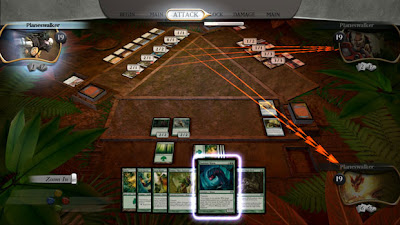
Magic: the Gathering Duels of the Planeswalkers Review
Let me preface this review by saying that since it is a timely review, I'm not going to bother to evaluate this game in a long term sense. This review focuses mainly on whether or not you should buy this game. If you want to save yourself some time, I've copied and pasted the final three sentences of the review here for your convenience:Although in several areas it can disappoint, overall it is impossible to argue with the value proposition of Duels of the Planeswalkers. Whether you are new to the game, playing for the first time in five years, or already play in local FNMs or PTQs, if you own an Xbox 360 there is no reason you shouldn't also own this game.
This week, I was sick as a dog, which gave me a good opportunity to play Stainless Games' new Xbox Live Arcade game Magic: the Gathering Duels of the Planeswalkers. Right now, the game costs 800 MS Points, which is the equivalent of $10. At that price point, this is a fantastic game that should be in every gamer's collection. This is especially true if you also play Magic: the Gathering in paper, since you get a free $15 card (my friend's estimation of the value, not mine) with purchase.
Singleplayer Campaign
The singleplayer campaign for this game is pretty straightforward: challenge each of the decks to two duels and beat them over the course of the campaign. You will be playing against the AI, which is reasonable but nowhere near perfect. After each win, you will get a card to add to your deck. The confusing decision that the designers made here is that they allow you to grind victories against the same AI-controlled opponent over and over again. While you have to beat all of the opponents in the ladder in order to unlock all the decks, once you have unlocked all of the decks you can just play the same easy-as-pie opponent over and over again, depending on which opponent your deck is strongest against. Although I did not beat the entire campaign with all of the decks, I did beat all of the opponents with the Elf, Jund, and mono-green decks, which were the only three I attempted it with.
AI
The AI is probably one of the poorer parts of the game, overall. It is difficult for me to criticize it entirely, since I'm sure it is very substantial. It does make good decisions most of the time. However, there are many areas it could definitely improve:
- Mulligans: I'm not sure that it actually takes mulligans. I've seen it missing its second turn land drop before. It may take mulligans, but I've never seen it go to 6.
- Attacking, causing it to be dead on board: I can't tell you how many times I have three guys in play, and the AI has three guys in play with a few meager points of life left, but one of them is phantom warrior. In this case, regardless of my life total, or his, he will swing with it. In many of these circumstances, the AI literally causes him to be dead on the board, regardless of any tricks I may be holding. It seems like there should have been a line or two of code telling it not to attack if the extra creature that gets through deals lethal damage.
- While getting in for an extra 3 with giant growth is nice, its much better to 2 for 1 with it by making your attacking or defending creature 2/2 a 5/5, which is bigger than the other guy's 4/4, thus making him down a card while you are up the creature (which you would have normally lost) or the damage (4 points of life ~1 card) and down the card in hand. 2 for 1.
Another play mode of the game is Magic: the Puzzling. This gameplay variant is interesting and definitely showcases some of Magic's potential. Unfortunately, certain considerations (like card drawing) convinced Wizards and/or Stainless games that all of these puzzles should be a "can you find a way to win this turn, after drawing your card" question, which to me reduced their complexity. A few of them took me a couple tries, but most were fairly easy. I beat them all in a single sitting. I wish that I had earned a deck unlock or something more substantial than simple achievement points doing this, though. Overall, this was a quick addition to the game that didn't add any long-term value to me.
Multiplayer
The multiplayer modes are, in my opinion, the highlight of the experience. As of the second night after release, there were already a fair number of people playing the game online, although actually joining a game is a bit finicky (this may change as more people begin to play online). There are several multiplayer modes available:
- Coop campaign (not online)
- 1v1
- 3 player FFA
- 4 player FFA
- 2v2 2 Headed Giant
Coop Campaign
The Coop campaign is also awesome, because it's a great way to get your friend to play with you without having to worry about them being intimidated by your prior experience with Magic. While you can't play it online (to my knowledge), a friend and I played through most of it and it is quite a bit of fun. The elf deck is absurd in this mode, btw. One interesting thing to note is that you can unlock cards for decks in the Coop campaign, so you can use this to approximately double your unlock rate vs. single player play.
Deck Construction/Balance Issues
Deck construction in this game is not what you would expect given that you are playing Magic: the Gathering. While in the paper game, you have almost complete control over everything you play, in this game each deck has a core deck which you can unlock additional cards for, and then you may choose which of those unlocked cards you wish to play. Since most of the decks' unlocked cards are of the bomb variety, you end up playing almost all of them. The notable exceptions, however, are the "tooth" cards which basically all give you an additional point of life whenever someone plays a spell of a specified color. While these cards are alright in multiplayer (particularly 4 player FFA), in singleplayer or 2v2 they're atrocious and should almost never be played.
My theory for these deck restrictions is this: Stainless wanted to delicately control the balance of the metagame, and the best way to do that is to have all of the decks' potential under control. Because there are a couple of bad/undesirable cards in most of the decks, it is basically impossible to modify the decks into unstoppable, efficient killing machines. If everyone could take the elvish warriors from the elf deck and put them into the green deck in the grizzly bears slot, or move the grizzly bears into the dragon fodder slot in the Jund deck, you could risk improving one deck too much and throw off the balance of the metagame.
However, if this was the reason, or even if it wasn't, Stainless should have done a better job of balancing the metagame. Some decks simply seem to be much better than others, particularly the elf deck, with which a decent draw can destroy almost any deck in the metagame. The blue, black, and red decks barely seem to be in the game at all, and the white deck is basically a FFA only affair, since its bombs are basically Serra Angel, Wrath of God (I'm told, haven't seen it yet), and Mass Calcify. The Naya deck seems to be completely trumped by the green deck, which simply trades some creature efficiency (no 3 mana 5/4) and removal for no mana issues and Overrun.
Expansion Opportunities
The most promising aspect of the game are the expansion opportunities it seems to present down the road. Adding onto this game should be fairly simple: just release a new deck for another 100-200 MS Points. Assuming that enough people download the base game, I'm sure future expansions are in the works. Heck, there's already a deck in the campaign that player's can't unlock yet. (Maybe I need to beat the double Tezzeret decks at the end of the Coop campaign, haven't done that yet).
Overall Impressions
Duels of the Planeswalkers is simply an outstanding value for 800 MS Points. While it's not perfect, it is certainly the most attractive Magic: the Gathering client ever, and gets most of the important aspects of Magic right. It is also easy to learn, beginner friendly and generally a rewarding first Magic experience. While it has its faults, these are more than made up for by the innovative, streamlined experience it provides and the enormous amount of content that you are purchasing for ~$10, even before you include the promo card which is worth the cost of admission alone. If you've always wanted to learn Magic, or even if you simply want to see how much better Magic Online's interface could be, I highly recommend that you take a look at this game. Although in several areas it can disappoint, overall it is impossible to argue with the value proposition of Duels of the Planeswalkers. Whether you are new to the game, playing for the first time in five years, or already play in local FNMs or PTQs, if you own an Xbox 360 there is no reason you shouldn't also own this game.
-Jon
Labels:
ccgs,
duels of the planeswakers,
magic: the gathering,
review,
xbla,
xbox 360
Monday, June 8, 2009
1 vs 100 Beta
So, my roommate and I just started playing the 1vs100 beta tonight. It is darned impressive. I grouped up with my cousin, his sister and a few of his friends and had a blast. The game is completely free to play (I haven't looked into the post-beta but I remember thinking that it was free to play then as well).Anyways its a great, social game that really pulls players together, even if they aren't in the same room (and they most likely aren't). My roommate got in on the action this evening and we are penciled in to playing it every night for the rest of the week.
I have the history and geography pretty covered, but am atrocious at the pop culture stuff (my roommate helps cover this deficiency somewhat). Regardless, I am still looking for more help. If you are smart and own an Xbox 360 with a gold XBL subscription, definitely hit me up. I might be a little late tomorrow (I work until 7PM, starts at 7:30, boo). Hit me up if you fit the above qualifications. My username is JohnnyJohstneft.
-Jon
Monday, May 25, 2009
Coop, Continued
I have spent a little time recently talking about the resurgence of cooperative play as seen in Left 4 Dead. This weekend, my cousin and I have been playing Gears of War 2 in coop, which I have never done before, and have been having a really fun time. In some sense, Gears of War 2 is a much better coop game than most other FPSs in my opinion, with L4D being the notable exception.As a single player game, I have never been terribly impressed with either of the Gears games. This is not an insult to Epic, but for some reason the series has never really been exciting for me. Personally, I think the guns lack personality (which is saying something when the assault rifle has a freakin' chainsaw on it, see above for a double chainsaw assisted kill). Basically, all of them feel more or less the same. There is the single-shot rifle which I usually use mid/long range, the aforementioned fully-automatic AR/chainsaw creation, a handful of pistols, and some awkward weapons which are always interesting but a little awkward to use effectively (mortar, et al.).
You also have the Gears themselves, who are big, hulking nasty brutes with hearts of gold. Unfortunately, their body armor slows them to the point that controlling them can sometimes be a pain. While the controls are a far, far cry away from the "please kill me now" control experiences of games like Stormrise, some aspect of the movement system has always put me off. It lacks the clean, smooth, responsive movement of Halo 1-3.
But Gears of War 2 is an absolute blast to play coop. It's still no Left 4 Dead, but it's a great experience working with the teammates, reviving them when they fall, and flanking enemies or racing to get a chainsaw kill/bash the head in of the last baddie who is barely clinging to life. The all-too-common forks in the road also work masterfully in the game, allowing you to cover and set up on your best buddy's flank. This is a much more fun coop experience than Halo 3, which for some reason always felt a little watered down and not very tactical, probably as a result of the level design and the respawn system.
The Xbox Live system, of course, really makes the magic happen, as you get about two-thirds the benefit of having your ally right there with you, but don't have to split off any precious screen real estate.
I haven't really gotten into horde mode much yet, but our experience with it has been very positive thusfar, and I'm looking forward to trying it some more in the next few weeks.
-Jon
Labels:
gears of war 2,
review,
xbla,
xbox 360
Saturday, May 23, 2009
Schizoid Impressions
Well the weekend is here, and seeing as I am finally getting a chance to stay in the city this weekend, I can try out some new games. However, my cousin, who doesn't play games not named Magic: the Gathering, is also in town, which may dampen my efforts somewhat. Not that that's all a bad thing.I did talk him into playing the Schizoid XBLA demo with me though. Schizoid is billed as a simple coop game in which a team of two ships, orange and blue, team together to fight hordes of alien monsters. The twist is that unlike other monster slaughtering games, there are no weapons. Ships can merely ram into one another. The orange ship pwns all the orange monsters, but gets pwned by the blue monsters, while the blue ship pwns the blue monsters, but rolls to the orange monsters. Pretty simple stuff.
Anyways, the game has something like 136 levels. We had a pretty good time playing the XBLA demo, but not good enough to make me want to slap down the money for the full game. Schizoid is overall a pretty intense experience, if the last few levels of the demo were any indication. There are tons of mobs all over the place, and it will take some pretty coordinated teamwork, but the game feels a little simpler than it could have been. The power-ups that I played around with were definitely fun, and I wish I could have seen some more. However, I wanted Schizoid to prove to me, beyond a reasonable doubt, that it a great, arcadey, coop experience, and it didn't quite get there.
If I had another dedicated player who wanted to really give this game their all with me, I would probably get it, but given that I don't have anyone living with me that would be willing to make the sacrifice, I suppose Left 4 Dead will have to do for now.
-Jon
Labels:
demo impressions,
schizoid,
xbla,
xbox 360
Monday, April 27, 2009
Games on Sale

So, I've been a busy guy for the last couple of days, with the nice weather we have been having in the city and all. I spent most of the day Sunday wandering around Manhattan's Best Buy stores, hoping to spike (acquire) some of the $10 Xbox 360 games that are on sale this week. I found most of what I got, but Soul Calibur was an early morning affair, I am told. I still managed to snag a copy of Pure and Unreal Tournament III, as well as a copy of Operation Darkness, which by all accounts is pretty sub-par but intrigued me enough to waste $10 on it.
All of this has gotten me thinking: Is it just me, or are games going on sale an awful lot lately? Ever since Steam started really upping the number of games it has on sale at any one time, and has started publishing numbers on the dramatic week on week sales increases this causes, everyone seems to be following suit. It makes perfect sense--many games only sell very well during their first few months--and gamers tend to be cheap, for whatever reason. (I myself am definitely in that category, no denigration intended).
In fact, for about the past year, but moreso in the past month or two, almost all of the non must-have games for me have been purchased because they were on sale: Prince of Persia, Braid, Armored Core 4 (I loved the original), Band of Brothers Hell's Highway, FarCry 2, and Burnout Paradise are all firmly in that category.
Is this something we are going to see more of? I daresay it seems to have been working so far. There was an article a few weeks ago about how Steam's free weekend of Unreal Tournament III single-handedly rejuvinated the multiplayer interest in that game.
As for my take on things, it's certainly not something that you want to do if your game is highly successful. I would never reccomend that Blizzard does something like that (actually I would love it if they did). Its just not needed in my opinion. However, if done well, like through the free weekend program, or the 1 year after launch sale that is well advertised, I think it can be fairly profitable. Games are always a low variable cost proposition, and especially with the trend towards online multiplayer, active player count is always essential to keeping interest in the game up.
Have you been buying games on sale? Have you found anything that you wouldn't have found otherwise? What games would you seriously consider buying if they were on sale, that you wouldn't otherwise consider?
-Jon
Labels:
commentary,
news,
pc,
video games,
xbla
Tuesday, April 21, 2009
Braid Review
Braid - Player of Game Review
Innovation: 9.5/10
Mastery: 10/10
Greatness: 9.5/10
So, it has been awhile since I've posted a formal review. My roommate and I have spent a good deal of time playing this game which you have probably heard of called Braid. While Braid appears at first to be a run of the mill side-scroller, don't let first impressions fool you. Braid may just be one of the most fulfilling gaming experiences that I've had the pleasure of playing. From beginning to end, Braid is one of the most finely crafted, innovative, and polished games on the market today, if not the most, ever.
Simply put, Braid is a side-scrolling puzzle game that plays with the concept of time in fascinating, dynamic and non-intuitive ways. Braid presents a relatively simple story--that of a boy/man/prince trying to find his princess, who is always, as a friendly walrus will frequently remind you, in another castle. To find his love, the protagonist plays his way through a series of worlds, each of which forces you to play with the flow of time in a unique way. There is the introductory world, a shadow world, a world in which movement affects time, a world with an object that slows time, and more. Each world is made up of several stages, in which there are several puzzle pieces to find. By obtaining all of the puzzle pieces from each world, players finish a picture of that world, and by finishing pictures in all of the worlds, proceeds to the final world in which the plot is resolved(?).
Braid is so unique from a game design perspective that it is easy to stop there and forget some of the other things that its creator, Jonathan Blow, has done.
First, Braid has an elegantly crafted and ultimately mind-blowing story. While it might not be that gripping at first--trust me--just keep reading the books as you go along. At some point in your experience, there will be a complete 180 degree shift in your understanding of the story. When that moment occurs, it's hard not to sit back and gaze in awe at how well you are led through the game, then violently shaken and forced to accept a second reality. In addition, there is at least one entirely different and revolutionary interpretation to the story which was brought to my attention by my roomate. It is crazy, and the more that I hear about this "alternate" understanding, the more I believe that it may be intentional. The plot, while not initially promising, should not be dismissed as one of Braid's strongest aspects.
Visually, the game is artistically profound and, again, well designed. Kudos to David Hellman, the lead (only?) artist, for creating such an impressive work. While technically, the graphics will not astound you, the visuals are fantastically crafted, and fit in with the game's storybook setting perfectly.
The sounds and music in Braid are outstanding as well. The music in particular, really brings out the somber, lost, and confused element of the game, and draws you in to Braid's fantastical world and sets the tone for the game. The sound design is strong as well, though there are few sound effects that really stand out (the ones that will always do it for me are the bunny/cat sound effects).
Puzzles are mind-bending and complex, but rarely too difficult to figure out after a long period of time. Many of them have multiple solutions. Most importantly, however, none of them are rehashes of other puzzles. Though some of them put you in similar situations (the boss battles come to mind), each of them has a different execution strategy. Moreover, the solution that you find first to a puzzle is rarely the best, as my roommate proved to me during his speed run (although I'm sure some of you have done better, I was more than impressed with his 39 minute completion time). All of them are elegantly designed, and force you to really tinker with your understanding of the flow of time in relation to the game world you are currently progressing through.
All of this would make for an outstanding recommendation, but the final piece of the puzzle to me lies in the fact that Braid's designers and developers seem to be truly wonderful people. Jonathan has given several speeches at gaming conventions, David has released the game assets for public consumption, and the music is available online. Braid has now been ported to the PC and Mac, where players can even create their own masterpieces using Braid's new level editor.
While Braid isn't exactly the only game you'll find yourself playing this year, I highly encourage you to go download a copy yourself. Regarding the statement that video games can indeed be art, I would submit Braid as exhibit number one in its defense. Braid is so phenomenally designed and executed on so many levels that it is hard to label it anything but a masterpiece.
Innovation: 9.5/10
Mastery: 10/10
Greatness: 9.5/10
So, it has been awhile since I've posted a formal review. My roommate and I have spent a good deal of time playing this game which you have probably heard of called Braid. While Braid appears at first to be a run of the mill side-scroller, don't let first impressions fool you. Braid may just be one of the most fulfilling gaming experiences that I've had the pleasure of playing. From beginning to end, Braid is one of the most finely crafted, innovative, and polished games on the market today, if not the most, ever.Simply put, Braid is a side-scrolling puzzle game that plays with the concept of time in fascinating, dynamic and non-intuitive ways. Braid presents a relatively simple story--that of a boy/man/prince trying to find his princess, who is always, as a friendly walrus will frequently remind you, in another castle. To find his love, the protagonist plays his way through a series of worlds, each of which forces you to play with the flow of time in a unique way. There is the introductory world, a shadow world, a world in which movement affects time, a world with an object that slows time, and more. Each world is made up of several stages, in which there are several puzzle pieces to find. By obtaining all of the puzzle pieces from each world, players finish a picture of that world, and by finishing pictures in all of the worlds, proceeds to the final world in which the plot is resolved(?).
Braid is so unique from a game design perspective that it is easy to stop there and forget some of the other things that its creator, Jonathan Blow, has done.
First, Braid has an elegantly crafted and ultimately mind-blowing story. While it might not be that gripping at first--trust me--just keep reading the books as you go along. At some point in your experience, there will be a complete 180 degree shift in your understanding of the story. When that moment occurs, it's hard not to sit back and gaze in awe at how well you are led through the game, then violently shaken and forced to accept a second reality. In addition, there is at least one entirely different and revolutionary interpretation to the story which was brought to my attention by my roomate. It is crazy, and the more that I hear about this "alternate" understanding, the more I believe that it may be intentional. The plot, while not initially promising, should not be dismissed as one of Braid's strongest aspects.Visually, the game is artistically profound and, again, well designed. Kudos to David Hellman, the lead (only?) artist, for creating such an impressive work. While technically, the graphics will not astound you, the visuals are fantastically crafted, and fit in with the game's storybook setting perfectly.
The sounds and music in Braid are outstanding as well. The music in particular, really brings out the somber, lost, and confused element of the game, and draws you in to Braid's fantastical world and sets the tone for the game. The sound design is strong as well, though there are few sound effects that really stand out (the ones that will always do it for me are the bunny/cat sound effects).
Puzzles are mind-bending and complex, but rarely too difficult to figure out after a long period of time. Many of them have multiple solutions. Most importantly, however, none of them are rehashes of other puzzles. Though some of them put you in similar situations (the boss battles come to mind), each of them has a different execution strategy. Moreover, the solution that you find first to a puzzle is rarely the best, as my roommate proved to me during his speed run (although I'm sure some of you have done better, I was more than impressed with his 39 minute completion time). All of them are elegantly designed, and force you to really tinker with your understanding of the flow of time in relation to the game world you are currently progressing through.All of this would make for an outstanding recommendation, but the final piece of the puzzle to me lies in the fact that Braid's designers and developers seem to be truly wonderful people. Jonathan has given several speeches at gaming conventions, David has released the game assets for public consumption, and the music is available online. Braid has now been ported to the PC and Mac, where players can even create their own masterpieces using Braid's new level editor.
While Braid isn't exactly the only game you'll find yourself playing this year, I highly encourage you to go download a copy yourself. Regarding the statement that video games can indeed be art, I would submit Braid as exhibit number one in its defense. Braid is so phenomenally designed and executed on so many levels that it is hard to label it anything but a masterpiece.
Wednesday, January 7, 2009
Review: Castle Crashers

Castle Crashers
First, a foreword: I spent quite some time thinking about the first game I would review on this website. Obviously, I decided on a game that I am fairly passionate about. However, as my first review, I also picked something that I could handle without biting off more than I can chew. I also picked a game that will highlight the difference between Player of Game and traditional gaming websites. Although I will give you a feeling of how much I enjoyed the game with every review, as a game designer I am also interested in the unique or particularly well-done aspects of a game. This manifests itself in each game having a dual score: the first serves as a traditional score, while the second is a reflection of a game's Greatness, a measure of the lasting impact this game should have, will have, or has had on gaming.
I look for two key things in every game I play: Innovation, and Mastery. A game without either is simply not a good game, but mastery traditionally accounts for a larger percentage of typical game reviews, while innovation is typically relegated to a bonus point category. First, let me loosely define these terms: Innovation represents the new things that a game does, while mastery applies to the refinement of gaming activity and the perfection of game design. Traditional gaming websites, I feel, are weighted more towards the Mastery aspect of this equation than Player of Game will be. While not every game will execute perfectly on innovative design (see Europa Universalis), I try to give credit where credit is due.
Games that might score lower on Mastery, but higher on Innovation include Spore, Europa Universalis, and Elder Scrolls III. Games that might score low on Innovation, but high on mastery include games like Halo 3, Warcraft II, or the Soul Calibur series of fighting games. Games which would score high on both scales include Grand Theft Auto 3, Half-Life, and World of Warcraft. Due to this rather unusual system of grading, you should not be surprised when I bestow a higher measure of Greatness on a game like Spore than I would on Warcraft II. In addition, you will find that my reviews almost always heap more praise on a game than is reflected in the Greatness score. This is because I find it hard to look for faults in excellent games.
With all of that said, nearly every game that I review here will be a good game, will be worth your time and effort (some highly innovative, but not terribly fun games will make appearances here), but some games simply have more potential than others to change the face of gaming. It is this measure of Greatness (capital G) that I will try to distill from each game that I review.
With that, on to the review!
Castle Crashers
Traditional Review
Gameplay: 9.5/10
Graphics: 9/10
Audio: 9/10
Overall: 9.2/10
Player of Game Review
Innovation: 5.5/10
Mastery: 9.5/10
Greatness: 7.5/10
Synopsis: Castle Crashers is a masterful side scrolling beat-'em-up that fuses strong base mechanics with top notch artistic design and solid multiplayer capability to create an arcade experience that we all can enjoy. While Castle Crashers does not extensively toy with side-scrolling convention, it executes so well that I find it difficult to resist employing the label "genre-defining".
Innovative Features: Dynamic and unique boss battles that are somewhat unusual for traditional side scrolling beat-'em ups, leveling system and melee combo attacks.
Masterful Features: Well adjusted difficulty setting, outstanding multiplayer experience, highly approachable, strong sense of humor, graphics (artistic).
Castle Crashers is an addictive and humorous sidescrolling beat-'em-up brought to us by the lovely folks at The Behemoth. As an Xbox Live Arcade download, it can be downloaded by anyone with an Xbox 360 and a high speed internet connection. One of the most popular XBLA (that's Xbox Live Arcade) downloads, Castle Crashers is at the forefront of a resurgence in old school gaming that has occurred in the past few years.
In Castle Crashers, you play as a cartoon knight who is tasked with saving a group of princesses, bringing an evil wizard to justice, and restoring order to the world. By completing a series of levels (you can revisit old ones you have already played), you will level up your hero and ultimately defeat various forces of evil, and shenaniganry, that have beset the land.
When you begin the game, you start with a basic melee weapon capable of performing two different attacks, and a single spell power. As you defeat enemies, acquire items, and learn new skills, you will gain an assortment of new melee attacks, a ranged attack, and even some nifty spells in your particular school of expertise. You will also gain access to upgraded weapons and a variety of pets, whose abilities range from allowing you to walk faster in water to periodically knocking down enemy combatants.
The environments in Castle Crashers go a long way towards making this game the sublime experience that it is. Environments are varied, and often bizarre, but always attractive and pleasing to the eye. What the game lacks in technical graphic prowess it makes up for in masterful artistic design, with a bold and pleasing color palette that never disappoints. Moreover, it reinforces the sort of action that is playing out on screen; it is hard to take the game too seriously, which significantly adds to its multiplayer appeal. The musical score in Castle Crashers is dynamic and well-chosen; it adds to the atmosphere and is definitely catchy, while the sound effects are meaty and draw the player into the action.
Yet what the game does best is create an experience that you feel comfortable sharing with your friends; its relatively low learning curve (as compared to most modern games) allows even non-gamers to get in on the action, which is great because its multiplayer is a blast.
Up to four players can get in on the action; these can be players on four different systems across the globe, using Xbox Live, or four players sitting across the couch from one another pounding soda and potato chips. Either way, the game is a hoot, and the multiplayer experience is at the heart of what makes this game so special. Players will fight over power ups and kissing the princess, work together to defeat impressive (and well-balanced) bosses, and laugh together at the particularly odd experiences they are bound to encounter during adventures.
While the multiplayer is one source of lasting appeal; the other comes from mastery of game elements and the lesson that Pokemon taught us: Players freakin' love catching 'em all. During your many adventures, you will slowly accummulate a mass of weapons with which to dispatch baddies, but the aforementioned coterie of lovable and adorable pets, each featuring a unique ability is particularly gripping.
Special mention should also go to the game's unique, well-inspired, and often hysterical bosses which you must dispatch from time to time. Each of them has different mechanics (it's not just the tank and spank from beat-'em-ups of yore), and nearly all are hilarious and fun to fight. While each of them is challenging, most everyone should be able to figure out how to beat them eventually (playing Castle Crashers will help with this quite a bit).
Overall, Castle Crashers is the type of experience that everyone can enjoy. While I would be hard-pressed to call it a particularly innovative game, its mastery of common beat-'em-up mechanics is without parallel, and this mastery is ultimately what makes the Castle Crashers gaming experience so rewarding.
Labels:
castle crashers,
review,
xbla,
xbox 360


